Guide
Debt Snowball vs Avalanche
The debt snowball pays off debts smallest balance first for fast motivation, while the debt avalanche pays off the highest interest rate first to minimize total interest. Both methods make minimum payments on every debt and attack one target at a time.
What is the difference between the debt snowball and avalanche?
The debt snowball orders debts by smallest balance first to win quick payoffs and motivation. The debt avalanche orders debts by highest interest rate first to save the most money on interest. Both make minimum payments everywhere and overpay one debt at a time.
| Debt snowball | Debt avalanche | |
|---|---|---|
| Pay-off order | Smallest balance first | Highest interest rate first |
| Biggest strength | Fast wins & motivation | Lowest total interest |
| Total interest paid | Slightly more | Least possible |
| Time to debt-free | Usually a little longer | Usually shortest |
| Best for | People who need momentum | Disciplined, numbers-driven payers |
Both methods share the same engine: you make the minimum payment on every debt, then throw every extra dollar at one target debt until it is gone. When that debt is paid off, you roll its freed-up payment onto the next debt. That rolling, growing payment is why it is called a snowball.
The only real difference is the order you attack. The debt snowball sorts debts from smallest balance to largest, ignoring interest rate. The debt avalanche sorts debts from highest interest rate to lowest, ignoring balance. The snowball is built for psychology; the avalanche is built for math. Both are systems, and a written system beats a vague intention. Map your balances first with a debt payoff tracker, then choose your attack order.
If you have never listed every debt in one place, that step matters more than the method you pick. Pull together balances, interest rates, and minimum payments, then learn the broader plan in our printable debt payoff trackers framework before committing dollars.
How does the debt snowball method work?
The debt snowball method lists debts from smallest balance to largest. You pay minimums on all debts, then send every extra dollar to the smallest balance until it is gone. You roll that payment to the next-smallest debt, repeating until debt-free.
Picture four debts: a $400 store card, a $1,800 medical bill, a $6,000 car loan, and an $11,000 student loan. The snowball ignores interest rate and attacks the $400 card first. You clear it in a month or two, get a fast win, then add that payment to the $1,800 medical bill, and so on up the ladder.
The snowball's power is behavioral. Each paid-off debt is a finish line you actually cross, and crossed finish lines keep people going. Research on debt repayment has found that focusing on the smallest balance first can improve follow-through, because early wins build momentum. For many real budgets, that momentum beats math.
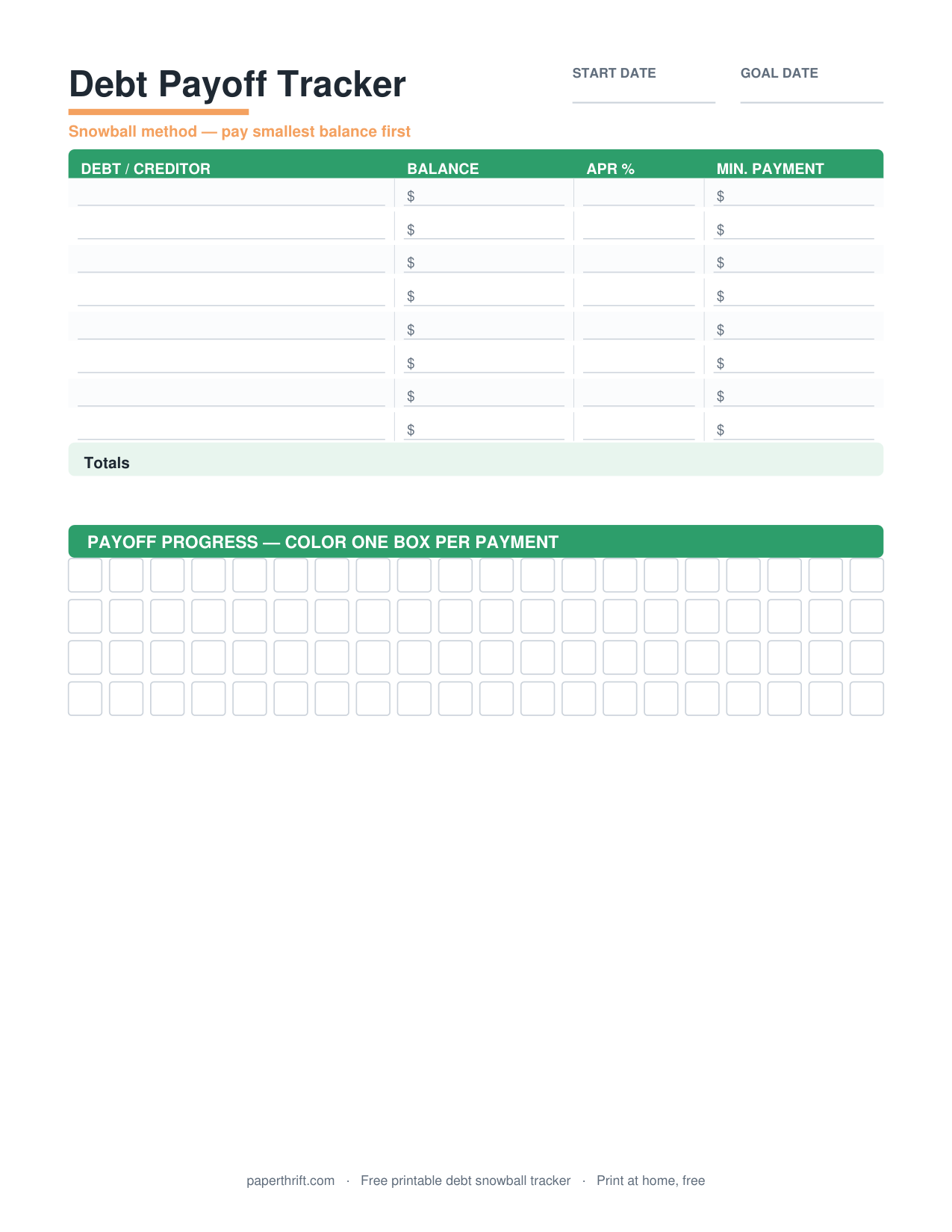
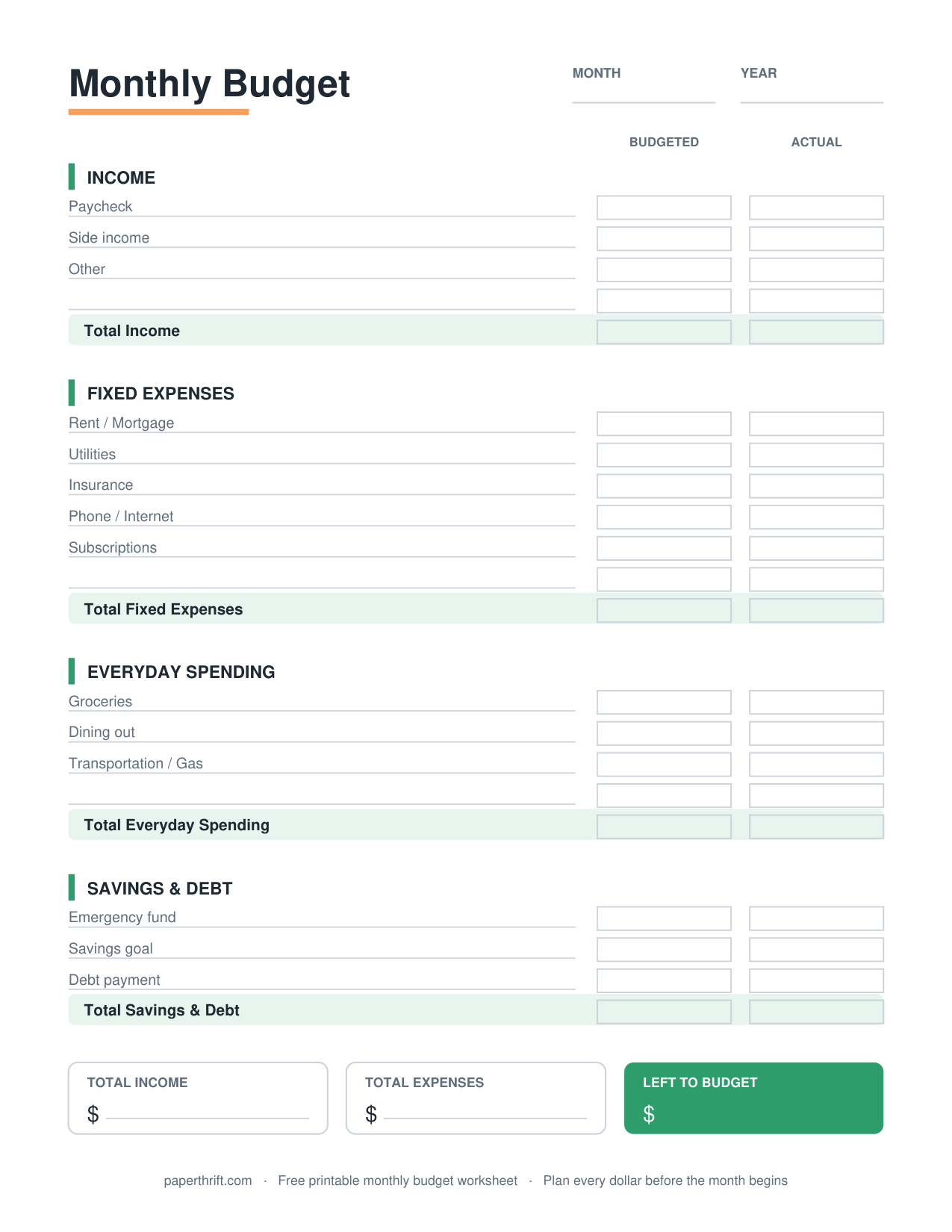
Track each knocked-out balance visibly so the wins feel real. A debt snowball tracker lets you check off debts in order, and pairing it with a monthly budget worksheet tells you exactly how many extra dollars you can send each month.
How does the debt avalanche method work?
The debt avalanche method lists debts from highest interest rate to lowest. You pay minimums on all debts, then send every extra dollar to the highest-rate debt until it is gone. You roll that payment to the next-highest rate, minimizing total interest paid.
Take the same four debts, but now look at rates: the store card at 26.99% APR, a credit card at 22%, the car loan at 7%, and the student loan at 5%. The avalanche attacks the 26.99% card first because that rate costs you the most every single month, regardless of balance.
The avalanche's power is mathematical. By killing the most expensive interest first, you reduce the total interest you pay and usually become debt-free slightly faster than with the snowball. On large, high-rate balances the savings can reach hundreds or even thousands of dollars over the life of the payoff.
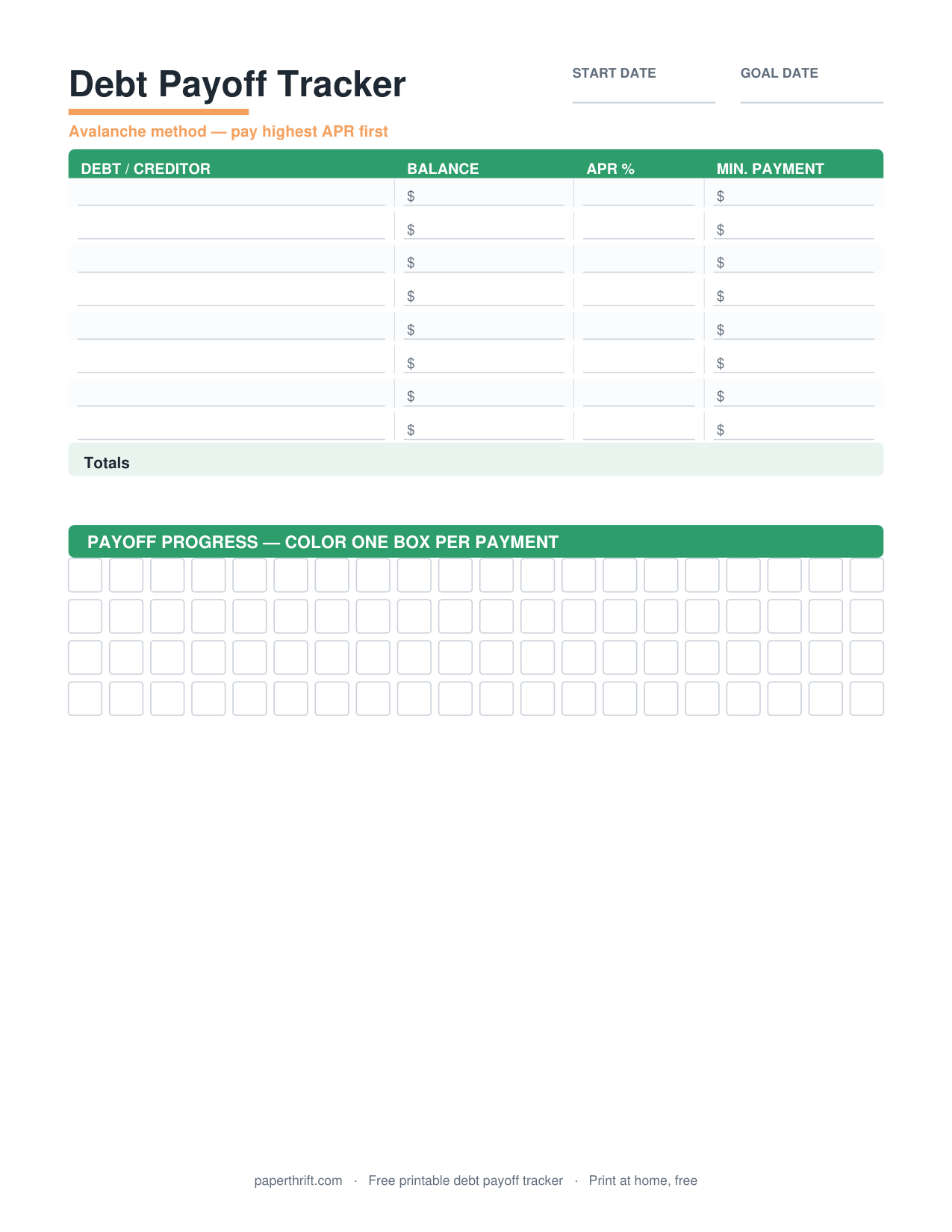
The trade-off: your first target may be a big balance that takes many months to clear, so early wins feel slow. Discipline matters more here. A debt payoff tracker that records interest rates keeps your priority order honest, and an expense tracker helps you find extra dollars to accelerate the highest-rate debt.
Which method saves more money, snowball or avalanche?
The debt avalanche saves more money because it eliminates the highest interest rate first, reducing total interest paid and often shortening the payoff timeline. The snowball usually costs slightly more in interest but delivers faster psychological wins that improve follow-through.
On paper, the avalanche always wins on dollars. Interest is the price of debt, and attacking the highest rate first lowers that price fastest. The size of the gap depends on your numbers: if your debts have similar interest rates, the two methods finish within dollars of each other, and the choice barely matters. The gap widens when you carry one small, very high-rate balance alongside large, low-rate ones.
But the cheapest plan on a spreadsheet is worthless if you quit it. The snowball trades a little interest for a lot of motivation, and for many households that trade pays off because they actually finish. The best method is the one you will stick with for the full payoff.
A practical hybrid exists: clear any tiny balance under roughly $500 for a quick win, then switch to strict avalanche order on the rest. Whichever you choose, build a small savings goal tracker starter emergency fund first so a surprise bill does not send you back to the credit cards.
A worked example: four debts, $300 extra per month
Take four common debts — a $400 store card at 26.99%, an $1,800 interest-free medical bill, a $4,500 credit card at 21.99%, and a $6,000 car loan at 6.5% — with $300 extra beyond the minimums each month. Here is how the two methods compare:
| Debt snowball | Debt avalanche | |
|---|---|---|
| First debt cleared | Store card (month 2) | Store card (month 2) |
| Debt-free in | 2 yr 0 mo | 1 yr 11 mo |
| Total interest paid | $1,519 | $1,164 |
| Second target | Medical bill (next smallest) | Credit card (next highest rate) |
The gap is real money — about $355 in this example — but it is small next to the cost of quitting halfway. Whichever list order keeps you paying the extra $300 every month is the method that wins.
Who should use the debt snowball vs the avalanche?
The debt snowball suits people who need motivation, have felt overwhelmed by debt, or have several small balances. The debt avalanche suits disciplined, numbers-driven people with high-interest debt who want to minimize total interest and can stay motivated without quick wins.
Choose the snowball if you have tried and stalled before, if a long timeline drains your willpower, or if you have a cluster of small debts you could erase fast. The early wins are a feature, not a flaw: they rebuild the belief that you can do this. Many people new to budgeting start here.
Choose the avalanche if you are motivated by efficiency, carry high-APR credit card debt, and trust yourself to keep going when the first target takes a while. If your largest balance is also your highest rate, the two methods agree and the decision is easy.
Either way, the method is only the engine. The fuel is the spare money in your budget. Free up cash with a 50/30/20 budget to direct 20% toward debt, and learn to assign every dollar a job using zero-based budgeting so nothing leaks away from your payoff plan.
How do you start a debt payoff plan with either method?
Start by listing every debt with its balance, interest rate, and minimum payment. Choose snowball (smallest balance) or avalanche (highest rate) order, build a budget to find extra payment money, then attack one debt while paying minimums on the rest.
Step one is a complete inventory. Write down every debt (cards, loans, medical bills, buy-now-pay-later) with its balance, APR, and minimum. You cannot plan around debts you are pretending not to see. A single debt payoff tracker page holds all of it in one view.
Step two is the order: smallest balance for snowball, highest rate for avalanche. Step three is finding the extra dollars, because both methods run on overpayment. Build the spending plan with a monthly budget worksheet, and follow the full setup process in our how to make a budget guide.
Step four is consistency: pay minimums everywhere, overpay your one target, and roll each freed payment forward. Tracking the climb keeps you honest, so mark progress on a debt snowball tracker every payday and watch the snowball grow.
To see both strategies against your own debts, the free debt snowball calculator lists your payoff order, debt-free date, and total interest. The motivation effect is real research, not folklore: a Kellogg School study of credit-card payoff behavior found people who cleared small balances first were more likely to eliminate their entire debt.
Frequently asked questions
Is the debt snowball or avalanche better?
Neither is universally better. The debt avalanche saves more money by killing the highest interest rate first. The debt snowball builds motivation by clearing the smallest balance first, which helps more people finish. The best method is the one you will actually stick with.
Does Dave Ramsey recommend the snowball or avalanche?
Dave Ramsey recommends the debt snowball method. His reasoning is that personal finance is largely behavioral, and the quick wins from paying off small balances first keep people motivated enough to finish the whole payoff, even though it may cost slightly more interest.
How much more does the snowball cost than the avalanche?
It depends on your balances and rates. If your interest rates are similar, the two methods finish within a few dollars of each other. The snowball costs more only when you carry small balances at low rates alongside large balances at high rates.
Can I switch between the snowball and avalanche methods?
Yes. A common hybrid clears one or two tiny balances first for quick motivation, then switches to strict avalanche order to minimize interest on the rest. You can change order anytime, just keep paying minimums on every debt and overpay one target at a time.
Paperthrift provides free educational budgeting tools and printables. It does not offer financial, investment, or tax advice.