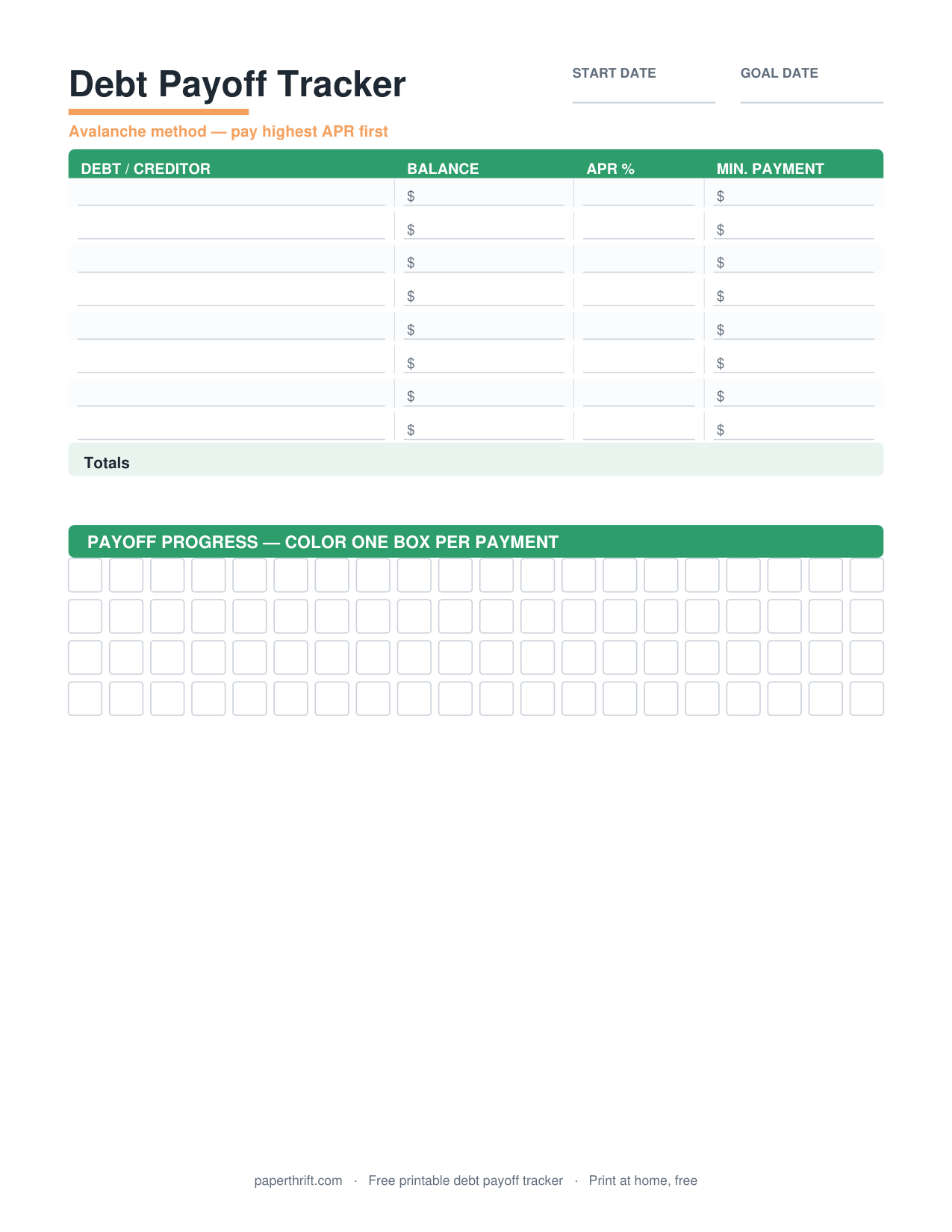
Debt Payoff · PDF
Debt Snowball Tracker
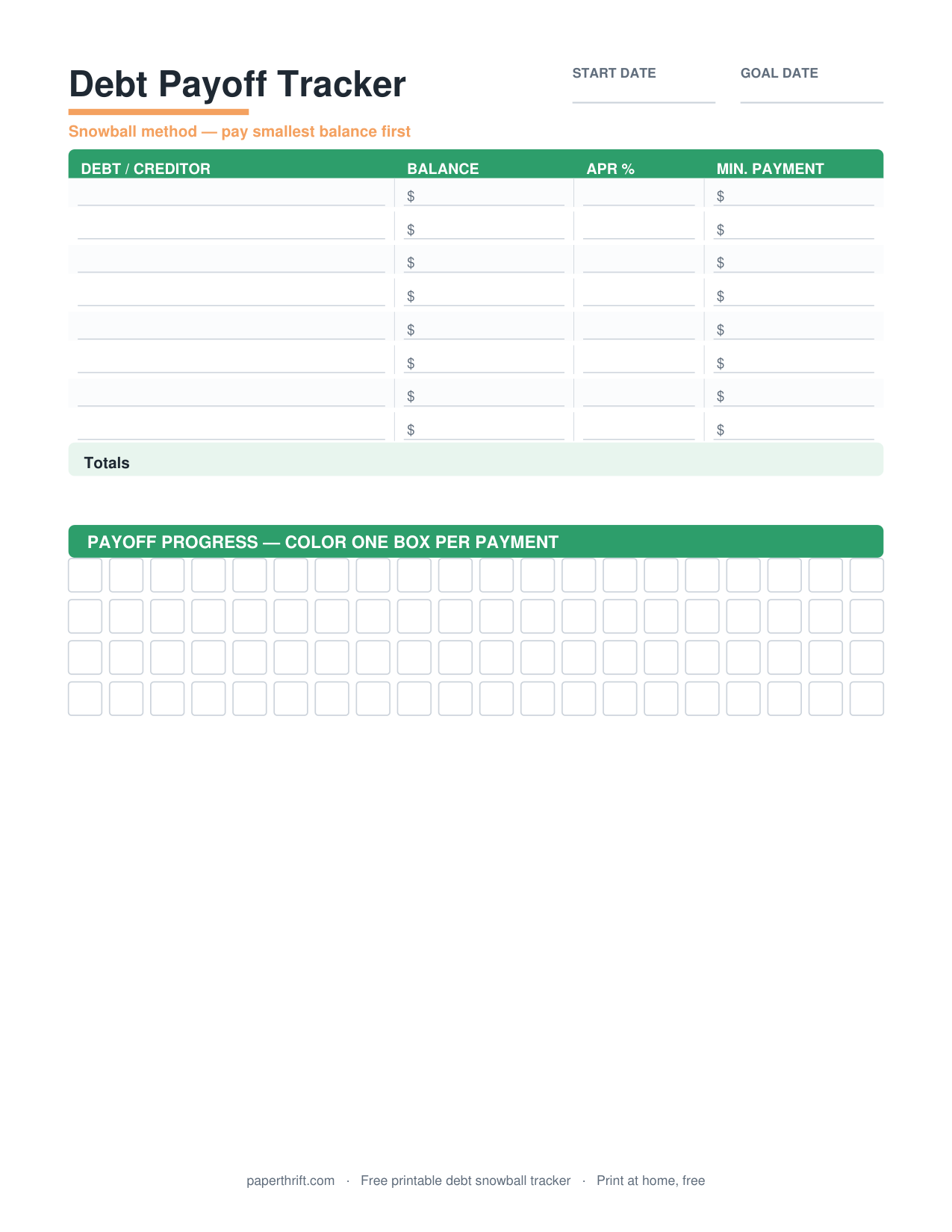
A debt snowball tracker is a printable worksheet that lists your debts from smallest to largest balance, so you pay the smallest first while making minimum payments on the rest, then roll each freed-up payment into the next debt.
Pick a color theme
What is a debt snowball tracker?
A debt snowball tracker is a printable sheet that orders your debts from smallest to largest balance. You attack the smallest debt first, pay minimums on the rest, then roll each cleared payment into the next debt to build momentum.
A debt snowball tracker turns the snowball method into a single page you can see and color in. You list every debt by balance from smallest to largest, record the minimum payment and interest rate for each, and mark progress as balances drop to zero. The order ignores interest rate on purpose, because the method is built on motivation, not math.
Each time you clear a debt, you roll its old payment into the next-smallest balance, so your payment toward debt number two grows. That growing payment is the "snowball." Pair this sheet with a debt payoff tracker for visual progress bars, and read debt snowball vs avalanche to confirm this method fits your personality before you start.
How does the debt snowball method work?
List debts smallest to largest, pay minimums on all of them, and throw every extra dollar at the smallest. When it hits zero, add that payment to the next debt. Repeat until every balance is paid off.
The snowball method works in four repeatable moves: list, minimum, attack, roll. First, list every debt by balance, smallest at the top. Second, pay the minimum on all debts to stay current. Third, send every spare dollar to the smallest balance. Fourth, when that debt is gone, roll its full payment onto the next debt.
Here is the math in plain numbers. Say you have a $300 store card, a $1,200 credit card, and a $4,000 loan. You clear the $300 card first and free up its $25 payment. You now pay the $1,200 card its old minimum plus that $25. Each payoff makes the next payment bigger, so debts fall faster over time. Find extra dollars to attack with by trimming spending on a monthly budget worksheet or a zero-based budget.
Why does the debt snowball work when other methods fail?
The debt snowball works because quick wins create momentum. Paying off a small debt fast gives a visible victory, which keeps you motivated. Behavior beats interest math for most people, so more people finish the snowball than the avalanche.
The snowball is a behavioral strategy, not a math strategy. A 2016 study from the Harvard Business Review found that focusing on smallest balances first was the strongest predictor of paying down total debt, because early wins build the confidence to keep going. Motivation is the scarce resource, so the method protects it.
The trade-off is honest: the avalanche method (highest interest first) saves more money on interest. If you are disciplined and want maximum savings, the avalanche fits better, and the debt payoff tracker handles either order. But if past plans fizzled, the snowball's fast first win is what keeps you in the game. Compare both side by side in debt snowball vs avalanche.
Want your payoff date before you print? The free debt snowball calculator shows your debt-free month and total interest in seconds — then the tracker turns that plan into visible progress.
How to use this printable
- List every debt Write each debt on the tracker: creditor name, total balance, minimum payment, and interest rate. Include cards, loans, medical bills, and money owed to family.
- Order smallest to largest Rank your debts by balance, smallest at the top. Ignore interest rate. The smallest balance is your first target.
- Pay minimums on everything Make the minimum payment on every debt to stay current and avoid late fees, while you focus extra cash on the top debt.
- Attack the smallest debt Send every spare dollar to the smallest balance until it hits zero. Check it off and celebrate the win.
- Roll the payment forward Add the freed-up payment to the next-smallest debt. Repeat down the list as each payment snowballs larger until you are debt-free.
How to print it
- Print at 100% scale (not "fit to page") so the columns and check-off boxes line up correctly.
- Choose US Letter for standard home printers or A4 if you are outside the US; both sizes are in the same free PDF.
- Print in black and white to save ink, then highlight each paid-off debt by hand for a visible win.
- Print one fresh copy each time you finish a debt, or laminate one sheet and track with a dry-erase marker.
Frequently asked questions
Is the debt snowball tracker really free?
Yes. The debt snowball tracker is 100% free with no email and no signup. Click the download link and the PDF opens instantly, ready to print at home on US Letter or A4 paper.
Should I include interest rates on the tracker?
Yes, record interest rates so you can see the full picture, but order your debts by balance, not rate. The snowball method sorts smallest to largest balance on purpose to deliver early, motivating wins.
What is the difference between the snowball and avalanche methods?
The snowball pays the smallest balance first for fast motivation. The avalanche pays the highest interest rate first to save the most money. Both clear debt; the snowball wins on momentum, the avalanche wins on math.
How do I find extra money to attack my debt?
Build a monthly budget, cut non-essentials, and cancel unused subscriptions. Every dollar you free up goes straight to your smallest debt. A budget worksheet or subscription tracker helps you spot the extra cash fast.
Does paying off small debts first hurt my credit?
No. Paying off any debt lowers your credit utilization and adds positive payment history, which generally helps your credit score. Clearing a small balance first removes one account and frees cash for the next debt.
Paperthrift provides free educational budgeting tools and printables. It does not offer financial, investment, or tax advice. For decisions about your specific situation, consider speaking with a qualified professional.