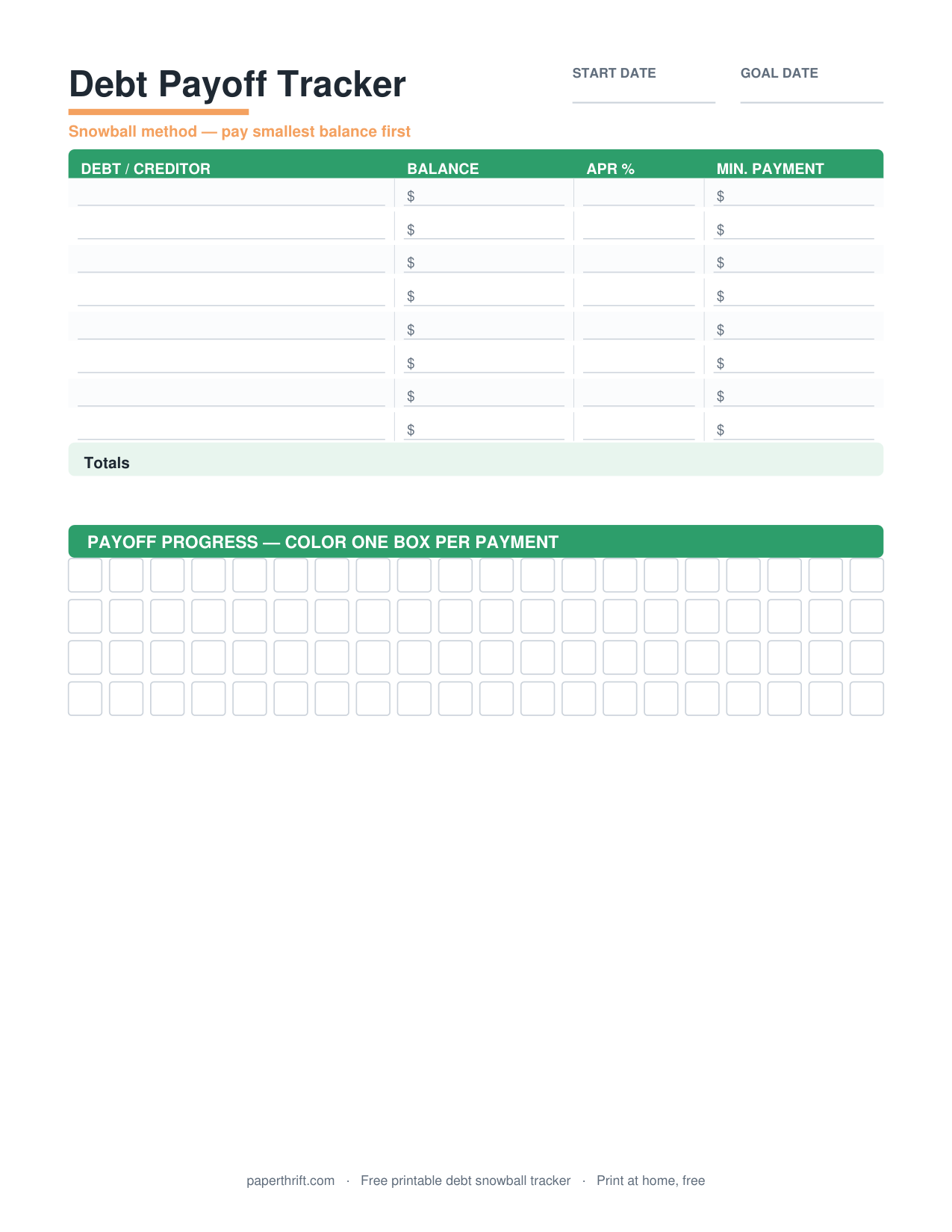
Debt Payoff · PDF
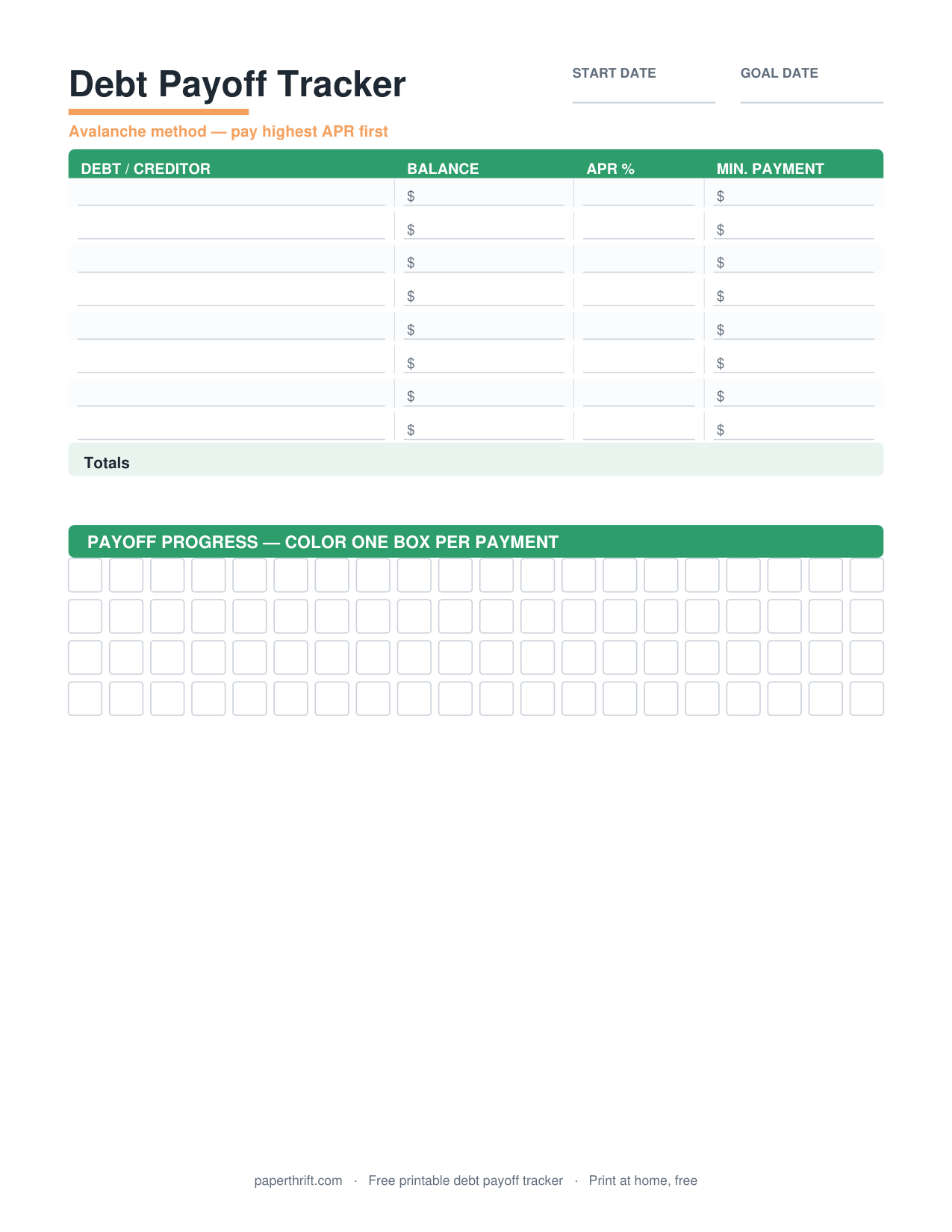
Debt Payoff Tracker (Avalanche)
A debt payoff tracker (avalanche) is a printable sheet that lists every debt by interest rate, highest APR first, so you target the costliest balance with extra payments while paying minimums on the rest, minimizing total interest paid.
Pick a color theme
What is a debt payoff tracker (avalanche method)?
A debt payoff tracker using the avalanche method is a printable sheet that orders your debts by interest rate, highest APR at the top, so extra money attacks the most expensive balance first while you pay minimums elsewhere.
The avalanche method ranks debts by APR, not balance. You list each debt, its interest rate, its minimum payment, and its current balance. Every extra dollar goes to the debt with the highest interest rate. Once that debt hits zero, you roll its payment into the next-highest-rate debt, and the payment you throw each month grows like a snowball rolling downhill.
This printable gives you one row per debt and a running balance column you fill in each month. Mathematically, the avalanche pays the least total interest of any payoff order, which is why it beats balance-based methods on pure cost. If you prefer quick wins over math, compare it with the debt snowball tracker and read debt snowball vs avalanche before you pick.
How does the debt avalanche method work?
The debt avalanche works in four steps: list every debt by APR highest to lowest, pay the minimum on all of them, send every extra dollar to the highest-APR debt, then roll that freed-up payment to the next debt once it is cleared.
Say you owe a 24% APR credit card ($3,000), a 9% personal loan ($5,000), and a 4% car loan ($8,000). The avalanche tells you to attack the 24% card first, even though it is not the biggest balance, because that rate costs you the most each month. You pay minimums on the loan and car while overpaying the card.
When the card is gone, you add its old payment to the personal loan's minimum, clearing it faster, then repeat for the car loan. Track each month's balance on the printable so you can watch interest shrink. Pair this with an expense tracker to find the extra cash, and a bill payment tracker so no minimum is ever missed and triggers a late fee or penalty APR.
Avalanche vs snowball: which should you use?
The avalanche saves the most interest by targeting the highest APR first; the snowball builds motivation by clearing the smallest balance first. Choose avalanche to minimize cost, snowball to stay motivated with fast early wins.
| Snowball | Avalanche | |
|---|---|---|
| Pays first | Smallest balance | Highest interest rate |
| Total interest | Slightly more | The least possible |
| First win | Within weeks | Can take months |
| Best for | Motivation and momentum | Pure math savings |
Both methods pay minimums on every debt and throw all extra money at one target. The only difference is which debt you target. The avalanche targets the highest interest rate, so it is the cheaper, faster route mathematically. The snowball targets the smallest balance, giving you a paid-off debt sooner and a psychological boost that keeps many people going.
Research on payoff behavior shows people who get early wins often stick with the plan, so the best method is the one you will actually finish. If you carry a high-rate credit card, the avalanche's interest savings can be large. Read the full debt snowball vs avalanche comparison, then grab the matching printable. If a freed-up budget is your goal, route the leftover into a savings goal tracker once the debt is clear.
Run your own numbers through the free debt snowball calculator first: it lists your payoff order, debt-free date, and total interest, so the tracker starts with a realistic plan.
How to use this printable
- List every debt Write each debt on its own row: creditor name, balance, minimum payment, and APR. Include credit cards, personal loans, car loans, student loans, and medical debt.
- Sort by interest rate Reorder the rows so the highest APR sits at the top and the lowest at the bottom. This ranking, not the balance size, drives the avalanche method.
- Pay minimums on everything Each month, pay the minimum on every debt to avoid late fees and penalty APRs. Mark each minimum as paid on the tracker.
- Attack the top debt Send every extra dollar to the highest-APR debt at the top of the list until its balance reaches zero. Log the new balance each month.
- Roll the payment down When the top debt is gone, add its old payment to the next debt's minimum and repeat. Update balances monthly to watch your total interest shrink.
How to print it
- Print on US Letter (8.5 x 11 in) or A4; set your printer scaling to 100% (Actual Size), not Fit to Page, so columns stay aligned.
- Use one printed sheet per quarter and write balances in pencil so you can update them each month without reprinting.
- Print in grayscale to save ink; the tracker is designed to stay readable without color.
- Choose black-and-white draft mode for everyday updates and save crisp prints for your budget binder.
Frequently asked questions
Is the debt payoff tracker really free?
Yes. The debt payoff tracker is 100% free with no email or signup required. Click the download link and the PDF opens instantly, ready to print at home on US Letter or A4 paper.
What is the difference between the avalanche and snowball trackers?
The avalanche tracker sorts debts by highest APR first to save the most interest. The snowball tracker sorts by smallest balance first for faster motivational wins. Both pay minimums on every debt and overpay one target.
Which debts should I put on the tracker?
List every debt that charges interest or has a payment: credit cards, personal loans, car loans, student loans, medical bills, and store cards. Rank them by APR, highest at the top, to follow the avalanche method correctly.
Does the avalanche method save more money than the snowball?
Yes. The avalanche method always pays the least total interest because it clears your highest-rate debt first. The snowball can cost slightly more in interest but delivers earlier wins that help many people stay motivated.
How often should I update the tracker?
Update the tracker once a month, right after you make your payments. Write each new balance in the monthly column so you can see your highest-APR debt shrinking and confirm your extra payment landed on the right debt.
Paperthrift provides free educational budgeting tools and printables. It does not offer financial, investment, or tax advice. For decisions about your specific situation, consider speaking with a qualified professional.