Budget Method · PDF
50/30/20 Budget Template
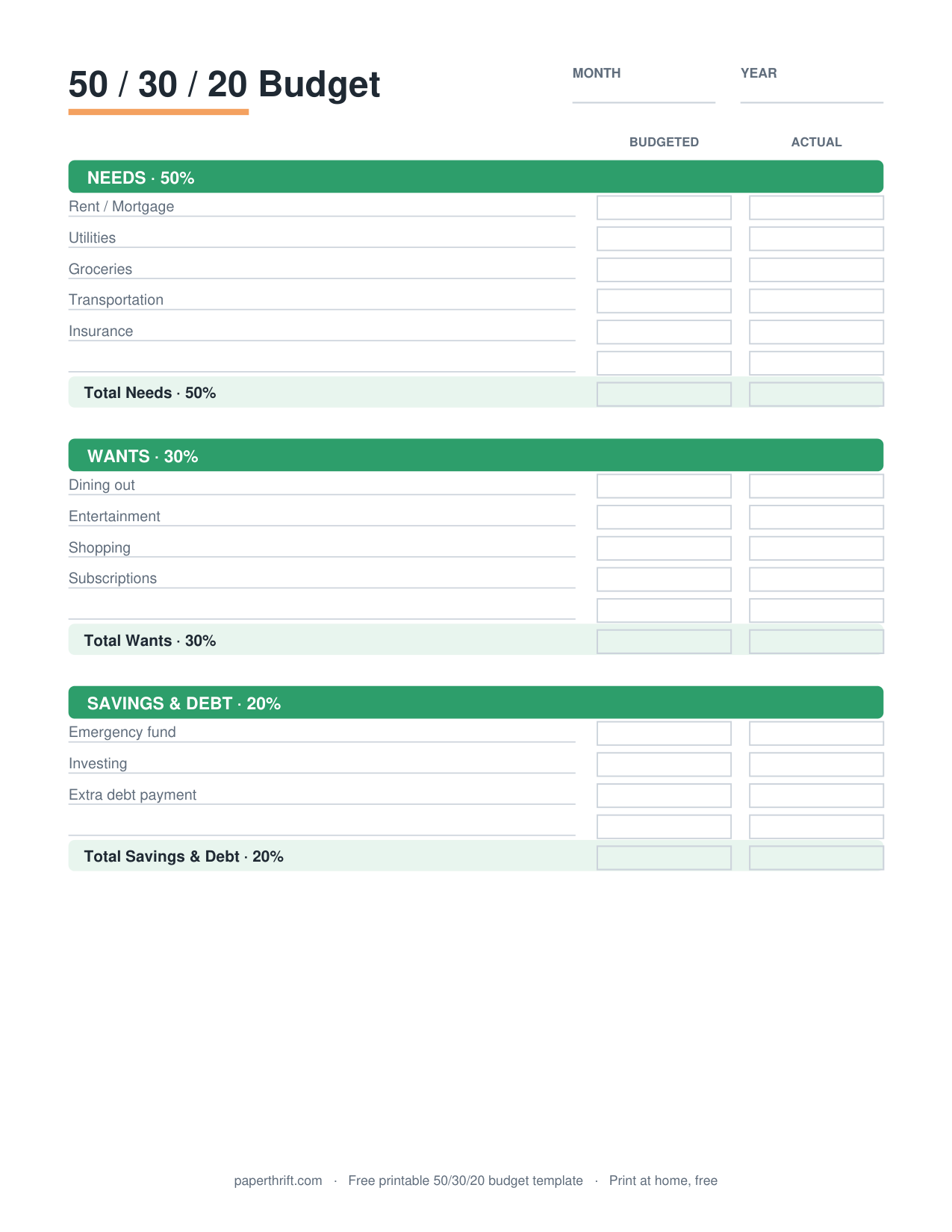
The 50/30/20 budget is a money method that splits after-tax income into three groups: 50% for needs, 30% for wants, and 20% for savings and debt payoff. Our free printable template gives you those three buckets to fill in.
Pick a color theme
What is the 50/30/20 budget?
The 50/30/20 budget is a method that divides your monthly after-tax income into three parts: 50% for needs, 30% for wants, and 20% for savings and debt. It keeps budgeting simple by using three rules instead of dozens of line items.
The 50/30/20 budget assigns every paycheck to three buckets based on percentages, not detailed categories. Needs take half your take-home pay, wants take just under a third, and the final fifth builds savings or pays down debt. Elizabeth Warren, then a Harvard law professor, and Amelia Warren Tyagi popularized the rule in their 2005 book All Your Worth, and it has stayed popular because the math is easy to remember.
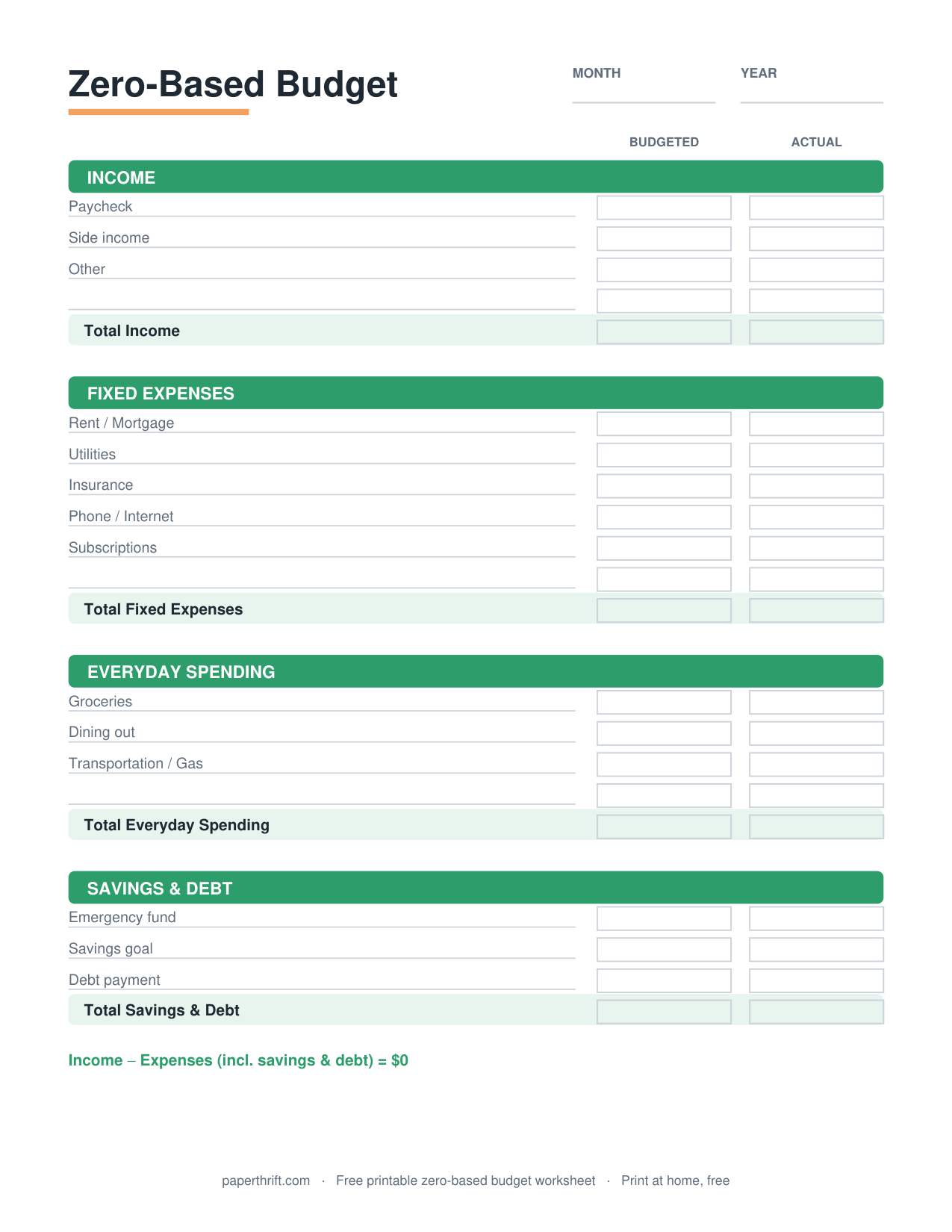
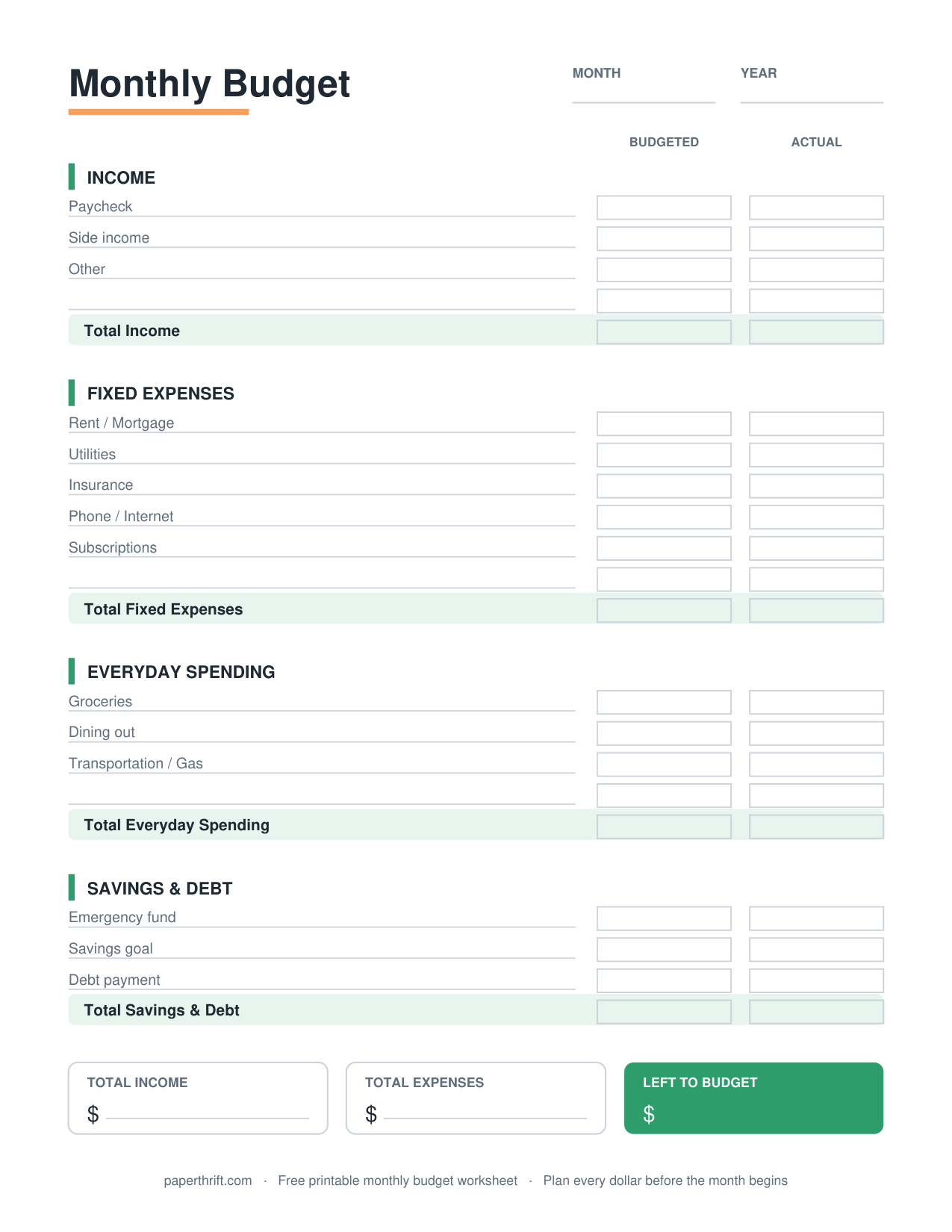
This printable template turns the rule into a one-page worksheet. You write your monthly income at the top, the template shows your three target dollar amounts, and you list expenses under each bucket. If you want a tighter, every-dollar approach instead, compare it with the zero-based budget; if you want the deeper background, read the 50/30/20 rule explained.
How do you calculate the 50/30/20 budget?
To calculate the 50/30/20 budget, take your monthly after-tax income and multiply it by 0.50, 0.30, and 0.20. On a $4,000 income, that gives $2,000 for needs, $1,200 for wants, and $800 for savings and debt. Adjust real spending to fit those targets.
The 50/30/20 budget uses after-tax (take-home) income, not gross pay. Start with the dollar amount that actually lands in your bank account each month, then split it three ways. On a $4,000 monthly take-home: needs get $2,000, wants get $1,200, and savings plus debt get $800. The printable does this math for you once you enter your income.
Needs include rent, utilities, groceries, insurance, and minimum debt payments. Wants include dining out, streaming, hobbies, and travel. The 20% bucket covers extra debt payoff and savings goals. If your needs run over 50%, trim wants first, then use a monthly budget worksheet or an expense tracker to find where the money is going.
Who is the 50/30/20 budget for?
The 50/30/20 budget is best for beginners, people with steady paychecks, and anyone who wants a low-effort budget. It suits earners whose needs fit within half their income, and it works well as a first budget before trying stricter methods.
The 50/30/20 budget rewards simplicity over precision, so it fits people who abandon detailed spreadsheets. It works best when your fixed needs stay near or below 50% of take-home pay, which is easier in lower-cost areas. Households in expensive cities often see needs climb past 50%, so they treat the percentages as targets to move toward rather than hard limits.
The rule is also a strong starting point that you can graduate from. Many people begin with 50/30/20, then switch to a tighter system once they want more control. If aggressive debt payoff is your priority, pair the 20% bucket with a debt snowball tracker, or learn how to make a budget from scratch before choosing a method.
If you'd rather not do any math at all, the free 50/30/20 budget calculator turns your take-home pay into all three targets instantly — copy them onto the printed template and you're ready to track.
How to use this printable
- Find your take-home pay Write your total monthly after-tax income at the top of the printable. Use the amount that hits your account, not your gross salary.
- Calculate your three targets Multiply income by 0.50, 0.30, and 0.20 to get your needs, wants, and savings dollar amounts. The template shows each target.
- List your needs (50%) Fill the needs bucket with rent, utilities, groceries, insurance, transportation, and minimum debt payments. Add the total.
- List your wants (30%) Add dining out, subscriptions, hobbies, shopping, and travel to the wants bucket. Keep this total at or under 30%.
- Assign savings and debt (20%) Direct the last 20% to an emergency fund, savings goals, and extra debt payoff. Adjust the other buckets until the plan balances.
How to print it
- Print on US Letter (8.5 x 11) or A4. Both sizes are built into the same free PDF.
- Set your printer to Actual Size or 100% scale, not Fit to Page, so the columns stay aligned.
- Print in grayscale to save ink; the template stays clear and readable without color.
- Print a fresh copy each month, or slip one in a sleeve and fill it in with a dry-erase marker.
Frequently asked questions
Is the 50/30/20 budget template really free?
Yes. The 50/30/20 budget template is 100% free. You download the PDF instantly with no email, no signup, and no account. Print it at home as many times as you like.
How do I fill in the 50/30/20 template?
Write your monthly take-home pay at the top, multiply it by 0.50, 0.30 and 0.20 to set the three targets, then list each expense under needs, wants or savings and compare the column totals to the targets.
Can I use the template with the 50/30/20 calculator?
Yes. Enter your income in the free 50/30/20 calculator on this site to get your three targets instantly, then copy them onto the printed template and track your spending against them through the month.
What counts as a want versus a need?
A need is an expense you must pay to live and work, such as rent, utilities, groceries, and insurance. A want is optional spending like dining out, streaming, and hobbies that you could cut if necessary.
Can I print the 50/30/20 template on A4 paper?
Yes. The same free PDF prints cleanly on both US Letter and A4. Choose Actual Size or 100% scale in your printer settings so the layout fits your paper correctly.
Paperthrift provides free educational budgeting tools and printables. It does not offer financial, investment, or tax advice. For decisions about your specific situation, consider speaking with a qualified professional.